
This blog has no mandatory terms of service, installs no beacons or cookies (that I know about), and vends no third party ads (I hope—let me know if you see one.) That’s just fine with our second Cluetrain Manifesto co-author of the summer reading list, Doc Searls.
(I do plug our workshops, but I think Searls would be OK with that. I think.)
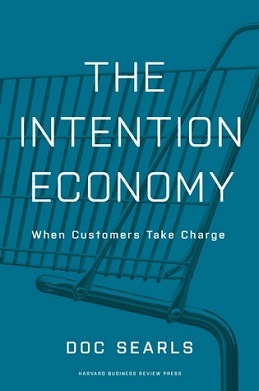
The Intention Economy: When Customers Take Charge. Doc Searls. (@dsearls)
Doc Searls is the leading light behind Project VRM, a movement designed to tip the balance of power away from vendor companies and back towards the customers they serve. (VRM is a twist on CRM—vendor relationship management rather than customer relationship management. We should be managing the vendors, rather than the other way around.)
Searls is a keen and wry observer of all that is absurd about the current situation. He takes particular aim at big data efforts designed to collect information to target advertising to us—leaving aside the privacy invasion, it’s not at all clear that we want or respond well to targeted ads. He also delivers a withering criticism of “contracts of adhesion,” the “click to accept” terms and conditions we acquiesce to at every turn that we don’t have time to review and that the vendor can change at will. There’s a terrible imbalance of power, and customers are being badly treated. Amen.
If this book’s intention had been to draw attention to the problem, I’d give it full marks. Unfortunately, he’s also proposing a solution, in the form of a scattershot of ongoing VRM projects. When stacked up against Facebook, Google, Acxiom, and Apple, VRM looks like pretty weak beer indeed.
Searls clearly believes that the unbalanced relationship between vendors and their customers is bad for the vendors, and that enlightened self-interest (coupled with some good hacks on the technology side) will cause vendors to lower their drawbridges, fill in their moats, and embrace customers as equal partners in value creation. The book is full of inspiring phrases like “free markets require free customers”—a fact that’s so blindingly obvious to Searls that it requires no further justification. Ironically, he cites the notoriously secretive and intentionally non-transparent Trader Joe’s as just this new kind of company. (Who really makes that Trader Darwin’s vitamin pill? They aren’t saying.)
The thing is, no serious vendor I know buys this. None is looking for new ways to cede control to their customers.
Searls’s defenders would say that this is unfair: that it’s early days for VRM, and revolutions take time. But I think the premise is fundamentally flawed.
Fundamentally, Searls is betting on individual consumers to care more about their rights and the personalization of their experience than they care about their convenience. From what I’ve seen, betting against customers choosing price and convenience first is wrong 100% of the time. He’s also imagining a time when Apple, or whatever company takes its place, is going to be open to negotiating legal terms with customers. I’ve worked with Apple Legal, and…no.
I’d deeply love to be wrong about all this.
I’d personally love a world where VRM was a reality. I’d also like a world with unicorns. Given the pace of genetic engineering, I’m guessing I get the unicorns first.


Leave a Reply